



Aerial Gym Simulator — Isaac Lab Edition
Welcome to the documentation of the Aerial Gym Simulator (Isaac Lab Edition)
The Aerial Gym Simulator is a high-fidelity, GPU-accelerated simulator for training Micro Aerial Vehicle (MAV) platforms to learn to fly using reinforcement learning. This fork has been fully ported to NVIDIA Isaac Lab (Isaac Sim 4.5.0), replacing the deprecated Isaac Gym backend. We offer aerial robot models for standard quadrotor platforms (base quad, x500, lmf2), each with a dedicated reinforcement learning environment and reward function. Policies train in minutes on a single GPU and can be visualized live in the Isaac Sim GUI.
This edition is open-source and released under the BSD-3-Clause License.
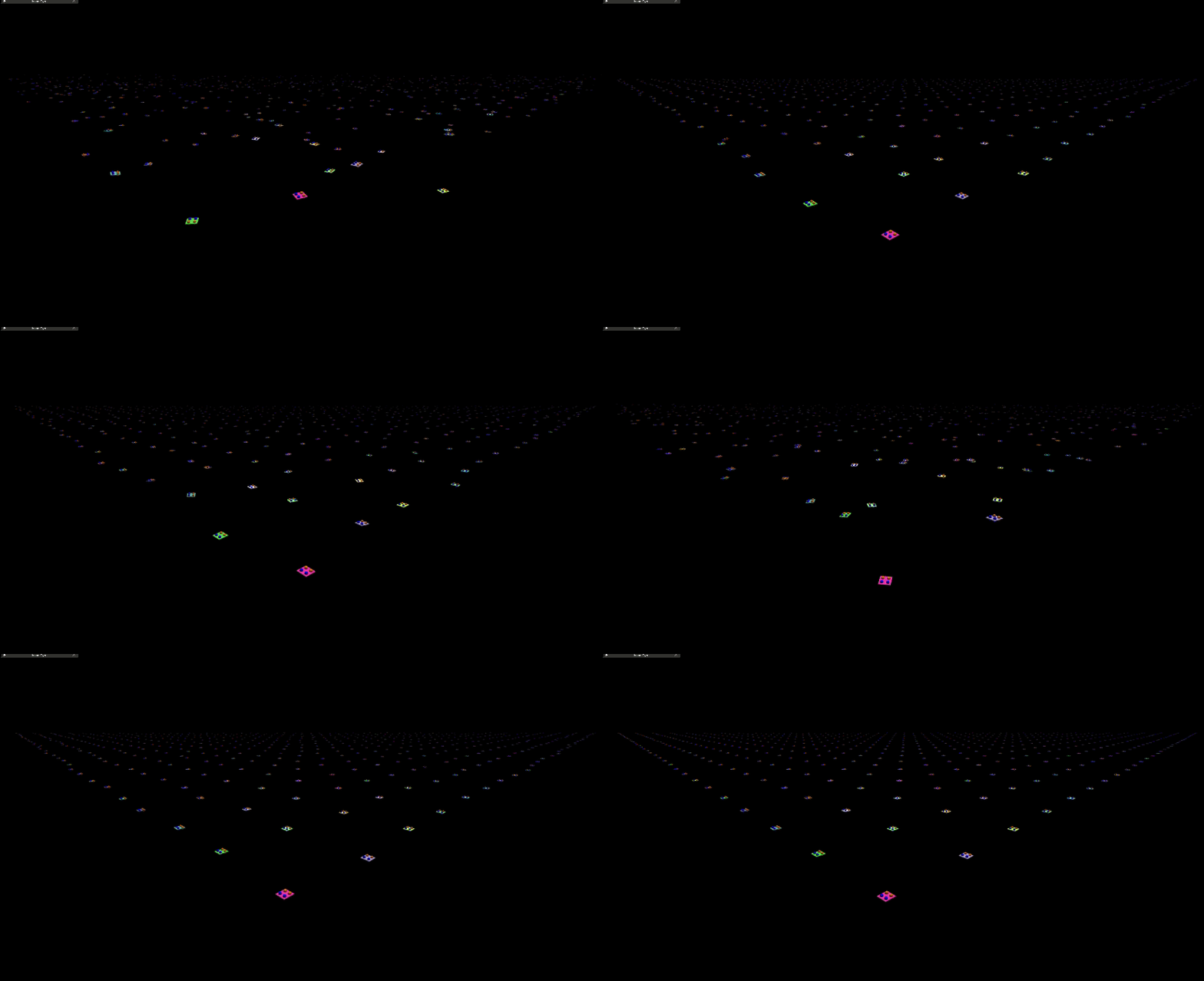
Train a hovering policy in minutes and watch it converge in the Isaac Sim GUI:
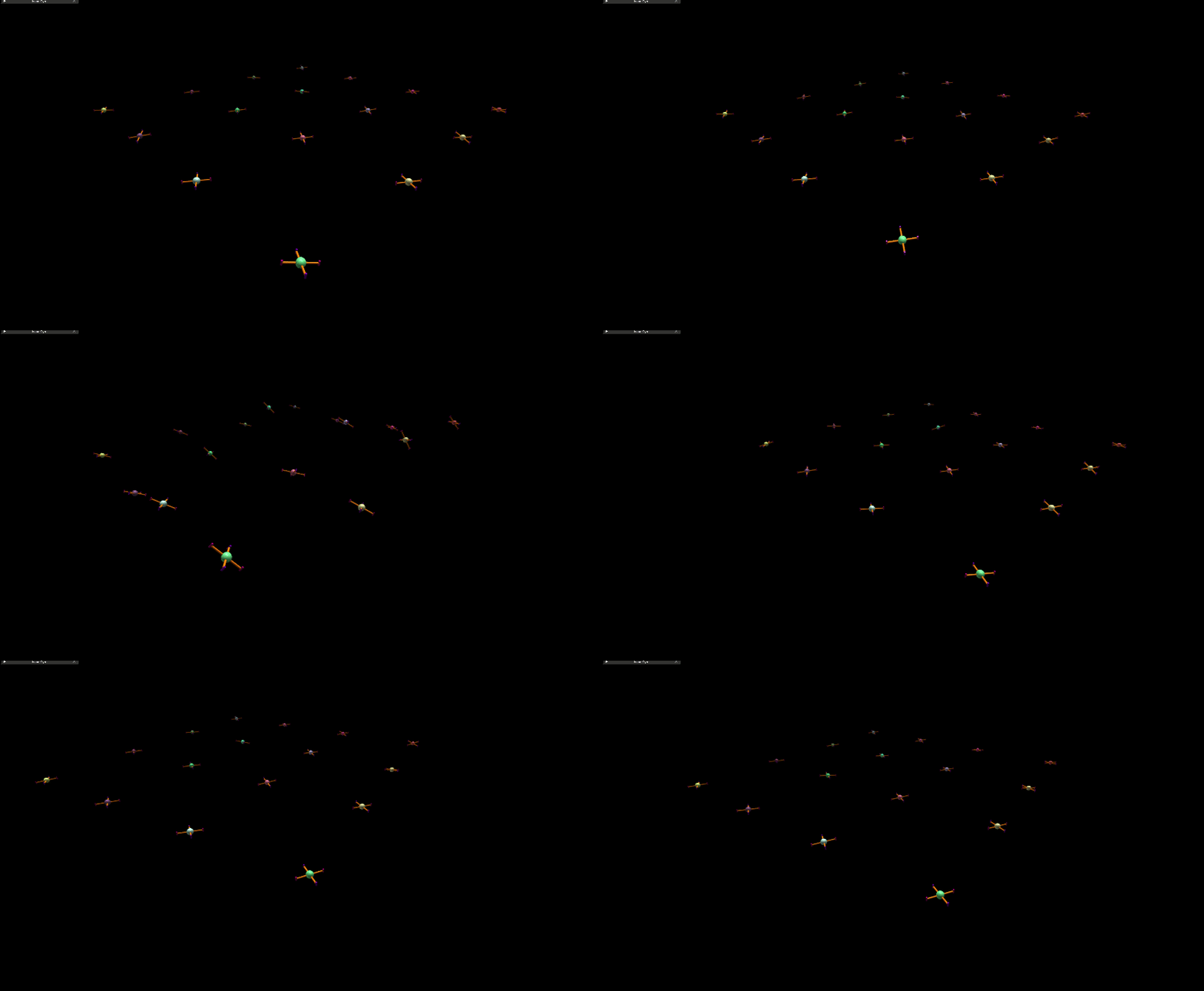
GPU-parallelized training across thousands of environments simultaneously:
Features
-
Isaac Lab Native
Fully ported to Isaac Lab 2.1.0 — no Isaac Gym required. UsesDirectRLEnvfor clean, minimal environment definitions with full Isaac Sim 4.5.0 compatibility. -
5 Ready-to-Train Environments
PositionSetpointEnv,PositionSetpointSim2RealEnv,PositionSetpointEndToEndEnv,PositionSetpointX500Env,PositionSetpointLMF2Env— each with a dedicated PPO config and play script. -
skrl PPO Training
Uses skrl 1.4.3 withRunningStandardScalerobservation normalization, fixed learning rate, and deterministic eval mode. Train headless with--num_envs 4096for fastest convergence. -
Testable Reward Functions
Reward functions are extracted into standalone@torch.jit.scriptmodules (sim2real_reward.py,end_to_end_reward.py,lmf2_reward.py) that can be imported and unit-tested without launching Isaac Sim. -
Rotation Utilities
rotation_utils.pyprovides quaternion ↔ rotation matrix ↔ ZYX Euler conversions, 6D continuous rotation representation for end-to-end policies, and small-angle wrapping — all JIT-compiled. -
Sim2Real Ready
Observation noise (position ±0.03 m, orientation ±0.02 rad, velocity ±0.02 m/s) baked intoPositionSetpointSim2RealEnvand lmf2. Asymmetriccloser_rewardin lmf2 penalizes retreating 3× harder than approaching. -
Unit Tests — No SimApp Needed
14 tests covering all reward functions and rotation utilities. Run in ~1.5 s on CPU with no GPU and no running simulator, using a custom import hook that stubsomni.*andisaaclab.simautomatically.
Why Aerial Gym Simulator — Isaac Lab Edition?
Isaac Gym was deprecated by NVIDIA. This edition migrates the full simulator to Isaac Lab, the supported successor, while keeping the same simple training interface. You get:
- One command to train —
train_skrl_position_setpoint.py --num_envs 4096 --headless - One command to visualize —
play_skrl_position_setpoint.py --checkpoint best_agent.pt --num_envs 16 - Fast iteration — reward functions test in 1.5 s without launching the simulator
- Three robot models — base quad, x500 (1.656 kg), lmf2 (1.24 kg, base-link wrench control)
- Checkpoint resume — training interrupted? Resume from any saved checkpoint
Policies converge in 5M environment steps (~2–4 h on a modern 24 GB GPU with 4096 envs).
Environments
| Environment | Obs | Robot | Notes |
|---|---|---|---|
PositionSetpointEnv |
13 | base quad | simplest hovering task |
PositionSetpointSim2RealEnv |
17 | base quad | sensor noise, sim2real reward |
PositionSetpointEndToEndEnv |
15 | base quad | rotation 6D obs |
PositionSetpointX500Env |
15 | x500 (1.656 kg) | per-motor force, 6D rotation |
PositionSetpointLMF2Env |
17 | lmf2 (1.24 kg) | base-link wrench, asymmetric reward |
Quick Links
- Installation
- Train a hovering policy
- All environments and training scripts
- Reward function design
- Unit tests
- FAQ & Troubleshooting
Citing
When referencing the Aerial Gym Simulator in your research, please cite the original paper:
@ARTICLE{kulkarni2025aerial,
  author={Kulkarni, Mihir and Rehberg, Welf and Alexis, Kostas},
  journal={IEEE Robotics and Automation Letters},
  title={Aerial Gym Simulator: A Framework for Highly Parallelized Simulation of Aerial Robots},
  year={2025},
  volume={10},
  number={4},
  pages={4093-4100},
  doi={10.1109/LRA.2025.3548507}
}
Contact
Ted Lin GitHub
For bugs and feature requests, please open an Issue on GitHub.
The original Aerial Gym Simulator was developed at the Autonomous Robots Lab, Norwegian University of Science and Technology (NTNU).
Acknowledgements
This Isaac Lab edition builds on the original Aerial Gym Simulator by Mihir Kulkarni, Welf Rehberg, and Kostas Alexis (NTNU ARL). Original work supported by RESNAV (AFOSR Award No. FA8655-21-1-7033) and SPEAR (Horizon Europe Grant Agreement No. 101119774).